Managers and key decision-makers juggling tight shipping timelines often run into two titles: freight broker and freight forwarder. They sound interchangeable, but they differ in who takes responsibility for the freight, how each is licensed and who is liable when something goes wrong. Making the wrong choice can lead to missed deadlines, damaged goods, customs delays or liability gaps you didn’t see coming.
This freight broker vs. freight forwarder comparison walks through what each provider does, how liability works and when to use each, so you can tell whether you need fast domestic capacity or a partner who manages more of the shipment for you.
What Is a Freight Broker?
A freight broker is a licensed intermediary that arranges truck transportation by matching shippers with motor carriers. The broker doesn’t own the trucks or take possession of the freight; it finds capacity, negotiates the rate and manages the booking. Working with freight brokerage services gives shippers access to a large carrier network without having to source and vet carriers themselves.
What Does a Freight Broker Do?
Think of a freight broker as the intermediary between shipper and carrier. A broker’s role typically includes:
- Connecting shippers with licensed carriers and negotiating freight rates.
- Arranging transportation and managing booking logistics.
- Tracking shipments and keeping both parties informed of delays or changes.
- Holding broker operating authority (an MC number) from the Federal Motor Carrier Safety Administration and maintaining $75,000 in financial security through a BMC-84 surety bond or BMC-85 trust fund.
Brokers don’t take custody or possession of your cargo. Most brokers focus on domestic road freight, including full-truckload (FTL) and less-than-truckload (LTL) shipments, rather than on customs clearance or international documentation.
A freight broker is also not the same as a customs broker. Customs brokers are licensed by U.S. Customs and Border Protection to file import entries and handle duties. Freight brokers arrange truck transportation and don’t handle customs.
What Is a Freight Forwarder?
Unlike a broker, a freight forwarder takes responsibility for managing a shipment from origin to destination, often across several carriers and modes. Most freight forwarding services specialize in international trade, though domestic freight forwarders also exist.
In the U.S., the two types are licensed differently. International ocean freight forwarders are licensed by the Federal Maritime Commission as Ocean Transportation Intermediaries. Domestic freight forwarders register with the FMCSA, typically consolidate smaller shipments and issue their own bill of lading, which makes them responsible to the shipper much like a carrier.
What Does a Freight Forwarder Do?
A forwarder coordinates the movement of goods on behalf of a shipper, including the carriers, documentation and regulatory requirements involved. The key difference between freight brokers and freight forwarders is scope: a broker books a carrier for you, while a forwarder manages the whole shipment.
Since over 80% of the world’s trade volume moves by sea, international shipping often involves ocean logistics, documentation and multimodal coordination. Forwarders are built to handle that work. A freight forwarder’s responsibilities typically include:
- Arranging cargo movement, preparing documentation and coordinating transportation on behalf of the shipper.
- Coordinating customs clearance through a licensed customs broker, along with export and import documentation and regulatory compliance.
- Consolidating shipments to optimize capacity and reduce shipping costs.
- Coordinating multimodal transportation across ocean, air, rail and road networks.
- Providing warehousing and storage at key points throughout the shipment journey.
- Holding an Ocean Transportation Intermediary license from the Federal Maritime Commission, for ocean freight forwarders and non-vessel-operating common carriers (NVOCCs).
- Maintaining $50,000 in financial responsibility for U.S.-based ocean freight forwarders, or $75,000 for NVOCCs.
This level of coordination means freight forwarders handle a scope of documentation and regulatory complexity that goes well beyond what a broker is licensed to manage.
The Liability Differences in a Freight Broker vs. Freight Forwarder Comparison
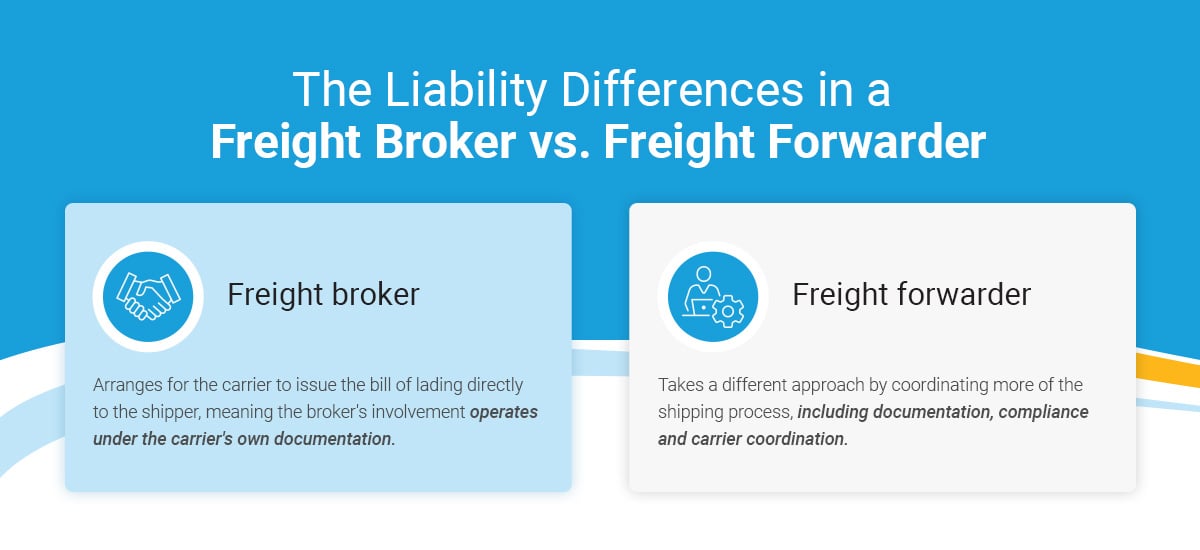
Licensing and operational scope aren’t the only factors that separate these two options. Liability also plays a major role in shaping which transportation solutions make sense for your shipment, and it usually comes down to one question: who issues the bill of lading?
When you use a broker, the motor carrier issues the bill of lading and physically moves the freight, so the carrier is liable for loss or damage in transit under federal law (the Carmack Amendment). The broker never takes possession of the cargo, so it generally isn’t liable for cargo damage unless it agreed to be in its contract with you or held itself out as the carrier. That’s why it matters that your broker vets carriers and confirms their insurance coverage.
A forwarder that issues its own bill of lading, such as a domestic freight forwarder or an NVOCC on an ocean shipment, stands in the carrier’s place and is responsible to you for the shipment from pickup to delivery, even when another carrier physically moves it. An ocean freight forwarder acting only as your agent, without issuing its own bill of lading, generally isn’t liable for cargo damage. Whichever provider you use, ask whose bill of lading you’re shipping under and what liability limits apply.
Freight Broker vs. Freight Forwarder at a Glance
| Freight Broker | Freight Forwarder | |
|---|---|---|
| Role | Arranges a carrier to move your freight | Manages the shipment on your behalf |
| U.S. licensing | FMCSA broker authority (MC number) | FMC OTI license (ocean) or FMCSA registration (domestic) |
| Financial security | $75,000 bond or trust fund | $50,000 ocean freight forwarder; $75,000 NVOCC or domestic forwarder |
| Bill of lading | Issued by the motor carrier | Domestic forwarders and NVOCCs issue their own |
| Cargo liability | The carrier | The forwarder, when it issues the bill of lading |
| Customs | Not involved | Coordinates clearance through a licensed customs broker |
| Best fit | Fast, flexible domestic truck capacity | Shipments that cross borders or modes, or need consolidation |
Do You Need a Freight Broker or a Freight Forwarder?
Global trade has surpassed $35 trillion, but for most shippers the choice between a broker and a forwarder comes down to three things: where your freight is headed, what kind of cargo you’re shipping and how much of the shipment you want your logistics partner to own.
When to Use a Freight Broker
A freight broker is likely to be the right fit when your priority is speed and access over full-service management. Consider using this service when:
- You’re moving freight domestically with no customs requirements involved.
- Your shipment is straightforward FTL or LTL freight, and speed or carrier access matters most.
- You need flexible, on-demand transportation capacity without taking on a full logistics partnership.
- Your shipment doesn’t require specialized handling, documentation or consolidation services.
When to Use a Freight Forwarder
A freight forwarder is usually the better choice once your shipment crosses a border and needs customs clearance. It also makes sense when a shipment moves across several modes in sequence, such as ocean to rail to truck, or when you want to consolidate smaller shipments.
When an Asset-Based Carrier Makes More Sense
High-value or sensitive freight raises a different question, because what protects it is who handles it rather than the provider’s title. For fixtures, furniture, electronics and other freight that needs blanket wrap, inside delivery or installation, an asset-based carrier with its own trucks, drivers and warehouses keeps one accountable team on the shipment from pickup to final placement. That matters most on tight project timelines, where splitting responsibility across separate vendors for each leg adds risk.
Many shippers use more than one, relying on a forwarder for international legs, a broker for flexible domestic capacity and an asset-based carrier for sensitive freight. A full-service logistics partner can walk you through how to choose the right freight forwarder and manage all three under one roof.
Freight Broker vs. Freight Forwarder FAQs
Is a freight forwarder the same as a freight broker?
No. A freight broker arranges for a carrier to move your freight and doesn’t take responsibility for the shipment itself. A freight forwarder manages the shipment on your behalf and, when it issues its own bill of lading, is responsible to you for it from pickup to delivery.
Can one company be both a freight broker and a freight forwarder?
Yes. Many logistics companies hold both broker authority and forwarder licensing, and some also operate their own trucks. Ask which role the company is playing on your shipment, because that determines who issues the bill of lading and who is liable.
Is a freight broker the same as a customs broker?
No. A customs broker is licensed by U.S. Customs and Border Protection to clear imports and handle duties. A freight broker arranges truck transportation and doesn’t handle customs.
Who is responsible if my freight is damaged?
Generally, whoever issues the bill of lading. With a broker, that’s the motor carrier. With a domestic freight forwarder or an NVOCC, it’s the forwarder. Review the bill of lading and your contract for liability limits before you ship, and consider cargo insurance for high-value freight.
Get Expert Freight Solutions From Corrigan Logistics
With the difference between a freight broker and a freight forwarder clear, the next step is finding a partner equipped to handle whatever your freight demands. Corrigan Logistics brings nearly 100 years of industry expertise, an asset-based fleet of our own trucks and drivers, and nationwide reach through UniGroup Logistics, backed by over 500 domestic warehouses and a global carrier network.
We offer full-service capabilities, including freight forwarding, freight brokerage, warehousing, white-glove service and Final Mile Delivery. This is all under one roof, and our team walks with you every step of the way, from the first call to the Final Mile. Learn more about the role of freight forwarding in global logistics, or contact Corrigan Logistics to discuss how our freight solutions can help you today.