Specialized equipment isn’t typical freight. Every shipment involves operational risk when you transport items that generate revenue, power production lines, support patient care or enable critical data infrastructure. That’s why it can be so costly when something goes wrong.
A recent Siemens industry analysis estimates that manufacturers can lose up to 11% of annual revenue to unexpected outages. Damaged CNC machines, delayed MRI installations or improperly secured turbine components can halt operations, delay revenue and erode your company’s credibility with customers and stakeholders.
Managing complex logistics requires more than booking a flatbed. It involves careful planning, regulatory coordination, asset protection and strict control of the chain of custody from pickup to final delivery.
This guide outlines the strategic framework operators use to move specialized equipment, while protecting asset integrity, maintaining compliance and safeguarding operational continuity at every stage.
What Qualifies as Specialized Equipment Transportation Logistics?
While not every oversized freight requires specialized logistics, you’ll need it when your cargo exceeds standard dimensions or requires careful handling due to weight, fragility, value or complex compliance requirements.
Anything that exceeds these Federal Motor Carrier Safety Administration limits for standard freight requires additional permits, routing coordination and compliance planning:
- 8.5 feet wide
- 13.5 feet high
- 53 feet long
Traditional logistics models prioritize delivering products on time and in optimal condition. Specialized equipment transportation builds on those values by adding engineering controls, environmental safeguards and risk-mitigation plans.
Industries that commonly rely on specialized equipment logistics include:
- Construction machinery, including cranes, excavators and loaders
- Industrial manufacturing systems, such as CNC machines and turbines
- Medical imaging devices — for example, MRI machines and CT scanners
- Agricultural equipment
- Technology infrastructure, e.g., server racks and data systems
- Energy and utility components
With over 490,000 employees at more than 38,000 establishments, heavy and specialized transportation is not a niche market — it is a vital part of the national infrastructure.
The High Stakes of Specialized Equipment Moves
Economy shipping isn’t always wise when you need to send mission-critical equipment. The risks go far beyond the freight invoice.
The Cost of Downtime
When equipment arrives damaged or delayed, the effects are immediate. Idle installation crews, postponed production schedules, missed construction deadlines and contractual penalties quickly outweigh transportation costs.
According to the Uptime Institute’s Annual Outage Analysis, over half of major operational disruptions result in losses exceeding $100,000, while 16% exceed $1 million. Facilities directors and operations leaders who handle capital projects must understand the relationship between equipment transportation and revenue protection.
Freight costs are predictable. Downtime is operational exposure.
Why Standard Freight Brokerage Falls Short
Standard freight brokerage models focus on speed and cost efficiency. They involve multiple handoffs between subcontractors, distribution hubs and third-party carriers. Each transfer increases the risk of damage, miscommunication and scheduling problems.
Specialized equipment transportation requires precision. It needs limited contact points, experienced drivers, custom securement and coordinated installation. When choosing a logistics partner, the contrast between brokerage coordination and engineered execution is crucial.
Core Challenges in Transporting High-Value Industrial Assets
Knowing how to transport specialized equipment successfully means addressing variables you can’t leave up to chance. Incorporate these challenges into your plan from the beginning.
Regulatory Compliance and Permitting
Oversized loads need state-specific permits, escort vehicles and approved travel windows. Regulations differ by jurisdiction, and interstate moves require synchronized permit timing and route surveys.
Compliance also includes:
- Hours-of-service regulations
- Driver vehicle inspection reports
- Securement standards
- Load classification requirements
Failing to anticipate regulatory complexities can hold up a move before it starts.
Site Constraints and Rigging Requirements
Getting equipment to the loading dock isn’t the end of the journey. Facilities may present:
- Tight dock clearances
- Elevator weight limits
- Floor load restrictions
- Crane access challenges
- Limited urban delivery routes
Pre-move site surveys ensure you can safely move equipment from the truck to its final location.
Climate Control and Vibration Sensitivity
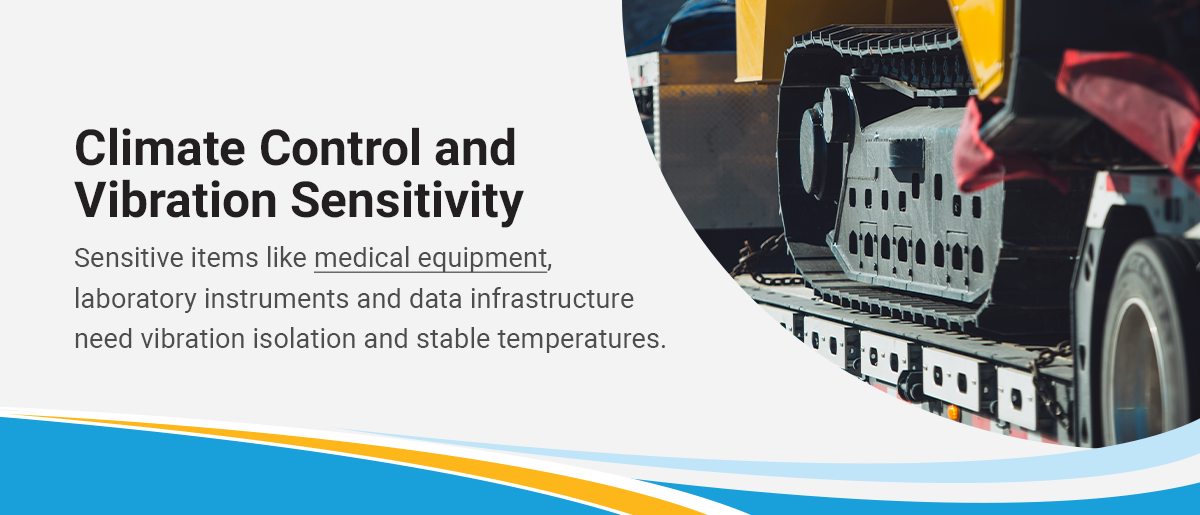
Sensitive items like medical equipment, laboratory instruments and data infrastructure need vibration isolation and stable temperatures.
Air-ride trailers, shock monitoring systems, vapor barriers and climate-controlled asset protection may be necessary to keep equipment intact during transit.
Planning a Zero-Failure Specialized Equipment Move
Effective specialized equipment transportation starts well before a truck arrives. A structured, engineered approach reduces uncertainty and protects operational continuity.
Assess Equipment Requirements
Start with complete documentation. Record dimensions, weight, center of gravity, balance points and lifting instructions. Identify fragile parts and see if partial disassembly improves safety.
Consider environmental factors. Will the equipment face temperature changes? Is moisture control needed? Consulting manufacturers on transport tolerances can help avoid costly mistakes.
Determine the Right Transportation Method
Choosing the right trailer type for the equipment is essential.
Options may include:
- Flatbed trailers for standard oversized loads
- Lowboy trailers for very tall cargo
- Step-deck trailers for height flexibility
- Schnabel trailers for extremely heavy or custom-engineered loads
Carrier equipment capability must precisely match the load requirements.
Secure Permits and Documentation
Permit processing times can range from several days to several weeks, depending on load classification. Necessary documentation includes dimensions, route details, travel restrictions and escort coordination.
Multi-state moves require synchronized approvals to avoid delays mid-route.
Engineer the Chain of Custody
An often-neglected aspect of specialized equipment transportation is maintaining a strict chain of custody. You must plan, monitor and document every stage to achieve zero-defect execution.
The most successful approaches include:
- Pre-move site surveys
- Custom crating with shock-mount bases and vapor barriers
- Asset-based transportation fleets
- Dedicated project managers
- Controlled handoffs
- Coordinated final delivery and installation
Strategic Risk Mitigation — Asset-Based vs. Brokerage Models
Choosing the appropriate logistics model directly affects risk exposure.
The Chain-of-Custody Advantage
Asset-based providers own their trucks and hire their drivers, leading to accountability, consistency and controlled communication. Trained drivers go through background checks that align with company safety standards.
Fewer subcontractor handoffs mean a lower risk of damage. One project manager overseeing the move simplifies coordination and improves visibility.
Why Insurance Coverage Isn’t Protection
Many people think insurance covers transportation risks. In reality, carrier liability coverage may represent only a small portion of the asset’s actual value. A financial payout doesn’t recover lost production time, missed deadlines or reputational damage.
Prevention, not compensation, should guide transportation strategies.
Best Practices for Successful Equipment Logistics
While engineered logistics frameworks lower risk, operational discipline can further improve outcomes, strengthen accountability and reduce surprises.
Before and during transit:
- Clean and secure equipment before loading
- Remove or protect loose components
- Shield exposed surfaces and controls
- Coordinate loading labor on-site
- Set up communication protocols
- Verify supplemental insurance coverage
- Use tracking and monitoring technology
- Document everything with photos
Corrigan Logistics Knows How to Move Specialized Equipment
Selecting a specialized equipment logistics partner involves considering much more than price. A trustworthy provider must operate specialized fleets engineered for high-value and oversized assets. They should also understand state-by-state permitting requirements and offer final-mile delivery services that extend beyond the loading dock.
White-glove installation, dedicated project management and proven experience with similar asset types are essential safeguards against costly disruptions. When moving mission-critical equipment, experience, engineering skills and careful execution set serious logistics operators apart from transactional carriers.
With nearly 100 years of experience, Corrigan Logistics offers asset-based, nationwide logistics solutions designed for critical assets. By maintaining control through owned fleets, trained personnel and high-quality final-mile delivery execution, Corrigan reduces unnecessary handoffs and protects the chain of custody at every stage.
From permits and custom crating to secure transport and on‑site installation, we manage every step with a single, accountable team focused on protecting your operation. When downtime isn’t an option and asset integrity matters, reach out to us to build a controlled, asset‑based transportation plan that delivers total chain‑of‑custody confidence.