
The mismanagement of physical assets can create cascading operational problems that directly impact profitability. Equipment goes missing, maintenance costs spiral out of control and procurement decisions happen without visibility into existing inventory. The most successful companies eliminate these challenges through structured approaches that create visibility, control spending, and prevent equipment failures before they disrupt operations.
Understanding how to overcome asset management challenges requires recognizing that these issues affect organizations across all industries and scales. Asset management challenges for businesses range from small inefficiencies that gradually erode margins to major operational failures that halt production entirely.
Explore three critical challenges and the systematic solutions that leading companies use to convert operational chaos into controlled, profitable asset strategies.
1. Inaccurate Asset Data and Poor Visibility
When asset records are maintained in spreadsheets, email threads or paper logs, inaccuracies are inevitable. Items get moved without being updated, damaged equipment stays on the books and entire categories of tools go untracked. Over time, the gap between what the records say and what actually exists on the ground widens until the data becomes unreliable.
The result is what the industry calls “ghost assets” — items that appear in your ledger but fall into these categories:
- Physically missing
- Broken
- Already disposed of
Ghost assets are more than an accounting nuisance. They create a chain reaction of operational problems, such as field crews expecting equipment that is not there or allocation decisions based on inventory counts that do not reflect reality.
For decision-makers, the concern is not just the individual incident but also the compounding effect. Every ghost asset degrades the reliability of every report, forecast and plan that depends on accurate inventory data. The fix starts with replacing scattered records with a centralized asset tracking system.
A centralized platform creates one reliable database where every asset is logged with its location, condition and assignment history. Teams gain real-time visibility into what is available, what is deployed and what needs service. This eliminates guesswork, builds accountability across departments and ensures the information driving your decisions is always current.
2. Uncontrolled Spending on Physical Assets
Once visibility breaks down, financial control follows. Without a reliable view of asset inventory, businesses routinely absorb costs that are entirely preventable. The most common include:
- Taxes and insurance on ghost assets: Equipment that no longer exists but remains on the ledger still generates property tax obligations and inflates insurance premiums. The business pays to cover assets it does not actually own.
- Redundant purchasing: Teams that cannot verify what is available in other locations end up buying replacements for equipment the company already owns. For instance, a construction crew might order new ladders for a jobsite while 10 are unused in another facility.
- Carrying costs on underutilized equipment: Idle assets still consume warehouse space, require climate control and tie up working capital that could be deployed elsewhere.
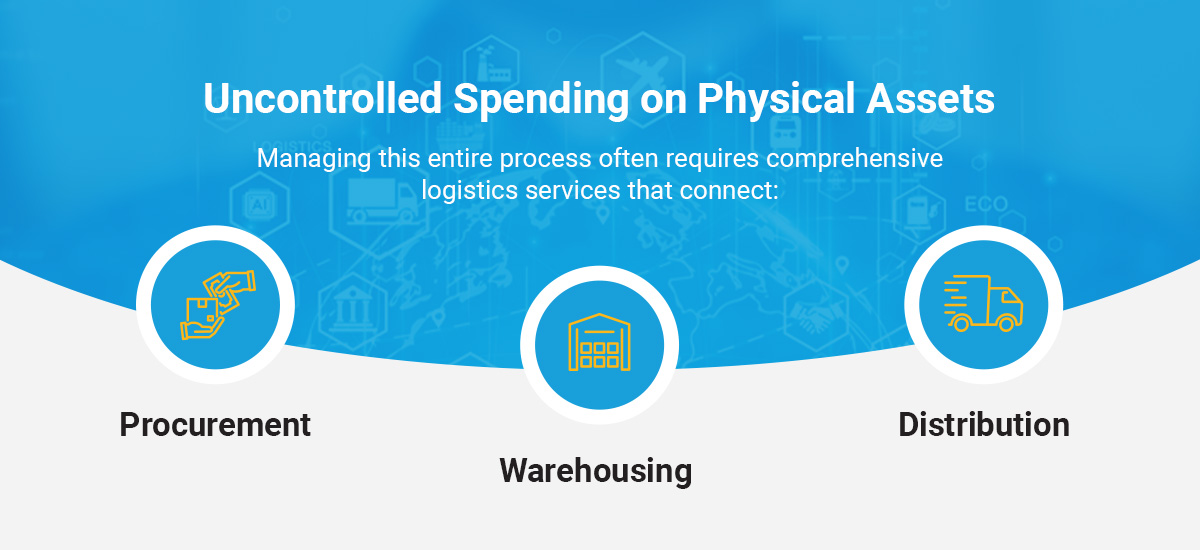
Managing this entire process often requires comprehensive logistics services that connect procurement, warehousing and distribution into one coordinated workflow.
3. Reactive Maintenance and Unplanned Equipment Downtime
When equipment fails without warning, the cost goes far beyond the repair bill. Unplanned downtime now costs the world’s 500 largest companies roughly $1.4 trillion per year, about 11% of their annual revenue. For businesses of any size, unexpected breakdowns disrupt workflows, stall revenue-generating activities and put enormous pressure on the teams left scrambling to recover.
Imagine a critical packaging machine failing in the middle of a peak production run. The immediate result is a halted line, but the ripple effects spread fast:
- Idle workers won’t be able to produce
- Downstream teams will need to wait for components
- A client deadline may suddenly look impossible to meet
Operating in this constant firefighting mode is exhausting. Each emergency repair carries premium costs for expedited parts and after-hours labor, and repeated breakdowns erode trust with clients who depend on your reliability.
Shifting to a proactive model changes the equation entirely. Instead of waiting for equipment to break, a proactive maintenance strategy uses service history and usage data to schedule inspections and repairs before problems surface. A modern asset management system can automate maintenance reminders based on hours of use, calendar intervals or condition thresholds, ensuring every piece of equipment gets serviced at the right time.
Proper storage also helps protect asset condition between deployments. Purpose-built warehousing solutions with climate control, organized racking and inventory management systems help ensure equipment stays protected and ready when you need it.
How to Build a Stronger Asset Management Strategy
Optimizing the management of physical assets is crucial for operational efficiency and sustained growth. A robust asset management strategy can transform potential losses into significant advantages, ensuring your business runs smoothly and cost-effectively.
Assessing the Core Problem
Inaccurate data, uncontrolled spending, and reactive maintenance represent symptoms of one fundamental issue — the absence of a systematic approach to managing physical assets. These challenges interconnect and amplify one another, leading to compounding operational losses over time.
Address the root cause through centralized tracking, data-driven financial planning and proactive maintenance strategies, and those compounding losses transform into compounding competitive advantages. The most effective solutions for asset management problems for businesses combine technology adoption with process standardization and staff training.
Organizations that successfully resolve asset management problems for businesses establish clear metrics for measuring improvement, such as asset utilization rates, maintenance cost reductions and inventory accuracy percentages.
Strategic Implementation for Lasting Improvement
Building an effective asset management system requires strategic planning and coordinated implementation. Success depends on integrating the right technology platforms with optimized processes and robust operational infrastructure. Organizations that attempt to solve these challenges piecemeal often find themselves managing multiple disconnected systems that create new inefficiencies.
The most effective approach involves partnering with experienced specialists who understand how these elements work together to create sustainable operational improvements.
Partner With Proven Asset Management Expertise
Corrigan Logistics brings decades of hands-on expertise, proprietary asset management software, and a nationwide network of over 500 warehouses to help organizations achieve complete control over their physical assets. Our integrated approach covers real-time tracking, predictive maintenance planning, and complete life cycle management. We provide both the technological tools and dedicated support teams needed to transform asset management challenges into measurable competitive advantages.
Organizations working with us typically see immediate improvements in asset visibility, reduced procurement costs, and significantly decreased unplanned downtime. Our comprehensive approach addresses the interconnected nature of asset challenges, ensuring that solutions create lasting operational improvements rather than temporary fixes.
Ready to stop reacting and start managing your assets with precision? To learn how our asset management services can streamline your operations, reduce costs, and protect the equipment your business depends on, contact Corrigan Logistics today.