
In 2025, global goods and services trade exceeded $35 trillion, connecting manufacturers, suppliers and buyers across
continents. For business owners and shipping managers, this scale brings opportunity and complexity. Multiple carriers,
shifting regulations, customs paperwork and constant risk of delays can turn a straightforward shipment into a logistical challenge.
A freight forwarder is the architect who brings order to this complexity. Acting as your logistics expert and single
point of contact, they coordinate every detail of your shipment across borders, modes of transport and regulatory
requirements. Explore the role freight forwarders play in global logistics and how partnering with an experienced
provider drives measurable growth for your business.
The Role of a Freight Forwarder
A freight forwarder is a logistics intermediary who arranges and manages goods transportation on behalf of shippers.
Freight forwarders design and coordinate the entire journey, while carriers — companies that own ships, aircraft or
trucks — physically move the cargo. They select the optimal combination of carriers, routes and shipping methods to
move your products efficiently from origin to destination.
The relationship between freight forwarding and global logistics is fundamental. Freight forwarders are strategic
partners who understand the full scope of international supply chains, from regulatory compliance to final delivery.
They bring specialized expertise that most businesses lack in-house, transforming a fragmented process into a seamless
operation.
Coordination vs. Transportation
The forwarder’s primary responsibility is project management and coordination. Think of forwarders as
logistics conductors who orchestrate multiple players, such as ocean carriers, trucking companies, customs brokers
and warehouse operators, to work in harmony. They evaluate your shipment’s requirements, negotiate rates, book cargo space
and monitor progress at every stage.
This expertise allows forwarders to find the best combination of speed, cost and reliability for each unique shipment.
Whether your goods require temperature-controlled transport or consolidated ocean shipping, a forwarder identifies and
executes the right solution.
A Single Point of Contact for Your Entire Shipment
Managing international logistics internally means juggling relationships with multiple carriers, navigating different
time zones and tracking down answers when issues arise. A freight forwarder eliminates this complexity by serving as
your dedicated logistics partner. One phone call or email connects you with an expert who has visibility into your
entire shipment and the authority to resolve problems quickly.
This streamlined communication saves time and reduces errors. Instead of coordinating between a trucking company in
Los Angeles and a customs broker in Shanghai, you work with one team that handles all these moving parts on your
behalf.
How Freight Forwarders Solve Global Trade Challenges
International shipping presents obstacles that can derail timelines, inflate costs and create significant risk.
Freight forwarders exist specifically to navigate these challenges, bringing experience and infrastructure that
protect your business.
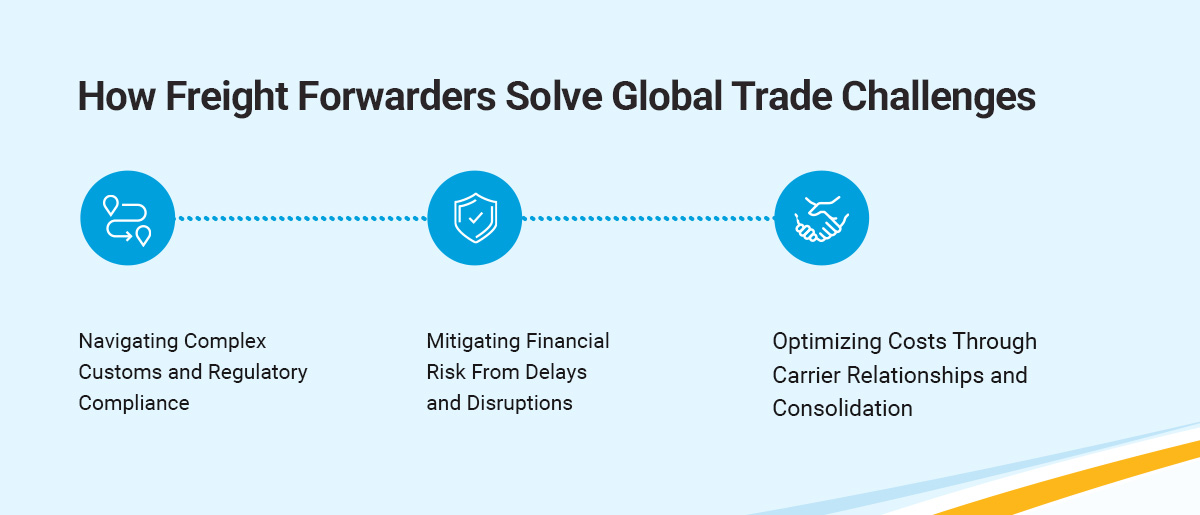
Navigating Complex Customs and Regulatory Compliance
Every country enforces its own import regulations, tariff schedules and documentation requirements, which all change
frequently. A single shipment crossing multiple borders must comply with each jurisdiction’s unique standards, from
product-specific restrictions to country-of-origin requirements. Staying current with these evolving regulations
demands specialized expertise that most businesses don’t maintain in-house.
When you experience documentation errors, your shipment sits at the border, racking up daily storage and demurrage
fees while your delivery window closes. Forwarders reduce this risk by staying up to date on international trade
regulations and verifying that all paperwork is accurate and complete before your goods reach inspection. This process
keeps cargo moving through customs efficiently.
Mitigating Financial Risk From Delays and Disruptions
Supply chain disruptions carry financial consequences, which drove 46.7% of organizations to purchase insurance
against major supply chain disruptions in 2024. Everything fromport congestion and weather events to labor strikes and
geopolitical tensions can derail scheduled shipments.
Freight forwarders build resilience into your supply chain by maintaining relationships with multiple carriers and
having contingency plans ready when disruptions occur. If the port closes, your forwarder reroutes cargo. If the
vessel is delayed, they’ve already secured space on an alternative ship or shifted to air freight. This proactive
management protects your delivery commitments and minimizes the financial impact of supply chain volatility.
Optimizing Costs Through Carrier Relationships and Consolidation
Freight forwarders leverage the collective volume they handle across all clients to negotiate better carrier rates
than most individual shippers can secure. This buying power translates directly into cost savings for your business.
For smaller shipments, forwarders offer consolidation services that combine multiple customers’ cargo into a single
container. This less-than-container-load (LCL) approach allows you to ship smaller quantities without paying for an
entire container, making international shipping economically viable even for modest order sizes.
Stages of the Freight Forwarding Process
Most freight forwarding engagements follow a similar operational pattern, though the specifics depend on your cargo,
timeline and destination.
1. Transportation and Carrier Management
The forwarder selects and books the appropriate transportation based on your timeline, budget and cargo
characteristics. Maritime shipping moves roughly 80% of global trade by volume, making ocean freight the backbone of international
logistics for most goods. Forwarders also coordinate air freight for time-sensitive shipments and ground transportation services for regional moves.
They handle booking confirmations, arrange pickup from your facility and coordinate transfers between different modes
of transport. This carrier management ensures your goods move efficiently through each leg of the journey.
2. Documentation and Paperwork
International shipments require substantial documentation to comply with export and import regulations. A freight
forwarder prepares and manages the essential documents for international shipping, including:
- Bill of lading (BOL): Serves as the contract between shipper and carrier.
- Commercial invoice: Details the transaction value and contents of your shipment.
- Certificate of origin: Verifies where your goods were manufactured.
- Specialized permits: May include inspection certificates or customs declarations, depending on your
products and destinations.
By handling this paperwork accurately and completely, forwarders prevent the delays and penalties that come from
documentation errors.
3. Warehousing and Distribution
Many shipments require warehousing solutions at some point in their journey, whether for temporary storage before
vessel departure, consolidation with other cargo or distribution to multiple final destinations after arrival.
Freight forwarders coordinate these warehousing needs, ensuring your goods are stored securely and moved efficiently.
For high-value or sensitive cargo, forwarders can arrange premium services that include specialized handling, climate control
and enhanced security. This white-glove approach protects valuable inventory and ensures it arrives in quality condition.
How a Freight Forwarding Partnership Drives Business Growth
The operational benefits of freight forwarding — smoother customs clearance, better rates and coordinated logistics —
ultimately serve higher strategic goals for your business.
Gaining Efficiency to Focus on Your Core Business
Managing international logistics internally requires specialized knowledge, dedicated staff time and ongoing attention
to changing regulations and carrier options. For most businesses, logistics is a necessary function that falls outside
their core competency.
Partnering with a freight forwarder allows you to redirect those internal resources toward product development,
customer relationships and revenue-generating activities where your team adds the most value.
Building a More Resilient and Reliable Supply Chain
In a competitive marketplace, supply chain reliability creates a meaningful advantage. Companies that consistently
deliver on time build stronger customer relationships and can command premium pricing. Understanding how freight
forwarding impacts global logistics becomes critical as businesses scale and customer expectations rise.
The explosive growth of e-commerce has raised the stakes considerably. Customers now expect faster delivery and
real-time visibility throughout the shipping process. A freight forwarder helps you meet these demands by building
responsive systems, maintaining backup plans for disruptions and continuously optimizing routes and methods as
conditions change.
Simplify Your Global Logistics With Corrigan Logistics
Navigating global logistics doesn’t have to be overwhelming. Corrigan Logistics brings over 90 years of expertise to
freight forwarding, project management and warehousing services, delivering the reliable, white-glove service your
business needs to succeed. As anasset-based provider with a nationwide network, we handle every detail so you can
focus on what you do best.
Contact us today to discuss your logistics needs and
discover how we can streamline your global supply chain.