Healthcare facilities manage complex supply chains where products move both ways. Hospitals, clinics and medical device manufacturers regularly handle returns, recalls, expired pharmaceuticals and decommissioned equipment — yet many lack formalized processes to manage these flows efficiently or compliantly.
Without structured reverse logistics, healthcare organizations face regulatory exposure, missed cost-recovery opportunities and potential patient safety risks. This guide breaks down everything you need to know about reverse logistics in the healthcare industry. It also highlights how to build a program that protects compliance, recovers value and supports patient care.
What Is Reverse Logistics in the Healthcare Industry?
Reverse logistics in the medical and healthcare industry refers to the organized backward movement of goods from the point of use back to suppliers, processors or disposal facilities. Unlike traditional forward logistics, which focuses on delivering products to end users, reverse logistics handles the return journey when items are defective, recalled, expired or no longer needed.
What makes healthcare reverse logistics uniquely complex is the nature of the products involved. Medical devices, pharmaceuticals and clinical equipment are often high-value, heavily regulated and clinically sensitive. Errors in handling can lead to consequences far beyond financial loss — regulatory penalties, patient safety incidents and compliance failures are all at stake.
Healthcare logistics already demands precision, but reverse logistics adds layers of traceability, documentation and disposal requirements that many facilities struggle to manage without formalized systems. The market reflects this growing complexity. The global healthcare reverse logistics market was valued at $56.8 billion in 2024 and is projected to reach $213.6 billion by 2033, expanding at a 17% compound annual rate. That trajectory signals an industry recognizing that reverse logistics is a core operational discipline with real financial and regulatory stakes.
What Healthcare Reverse Logistics Covers
Healthcare reverse logistics comprises a collection of distinct flows, each with its own handling requirements, regulatory considerations and operational demands. Understanding what falls under this umbrella helps organizations build systems that address every scenario compliantly and efficiently.
Medical Equipment Returns and Repairs
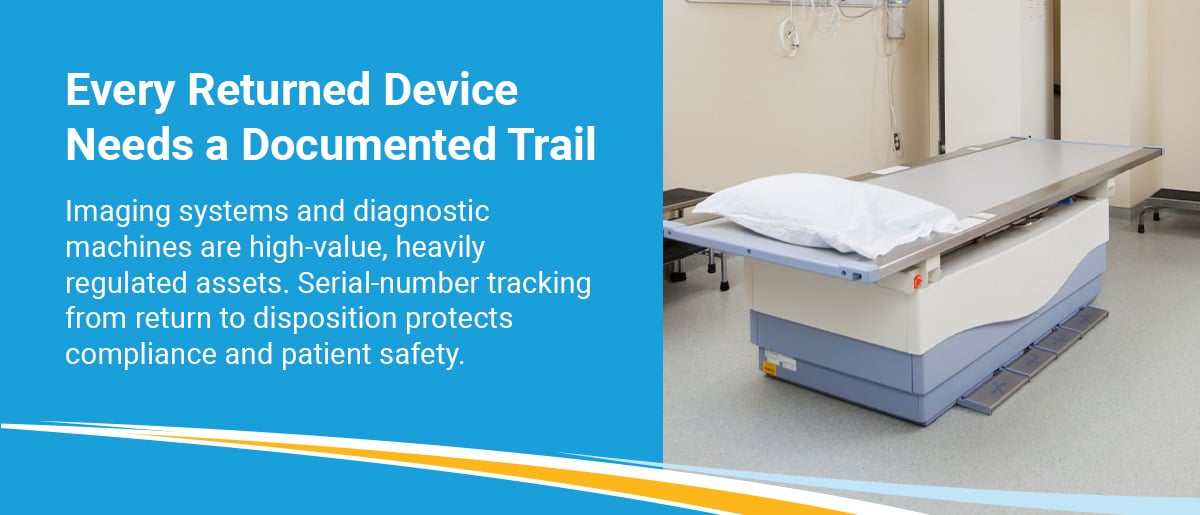
Medical devices include surgical instruments, diagnostic machines, imaging systems and patient monitoring equipment. This equipment follows a return and repair cycle when items are defective, damaged or require servicing. Returned assets must be received, documented, inspected and routed appropriately for repair, refurbishment, reuse or disposal.
Tracking devices by serial or lot number throughout the return cycle ensures regulatory compliance and operational accuracy. Having clear asset management and real-time tracking helps facilities reduce the risk of regulatory exposure and the potential reuse of faulty items.
Recalls, Corrections and Removals
Medical devices identified as violative — defective, mislabeled or unsafe — require rapid retrieval, documentation and removal from circulation. The Food and Drug Administration (FDA) classifies these events as recalls, corrections or removals, and monitors them based on health hazard severity. Class I recalls present the most serious risk of harm or death.
Organizations need clear, rapid-response processes to pull recalled items from inventory before they reach patients. The stakes for patient safety are high. Supply chain systems must operate swiftly with complete documentation to demonstrate compliance and protect against liability.
Pharmaceutical and Hazardous Waste Disposal
Expired, unused or hazardous pharmaceutical waste is a highly regulated area governed by the Environmental Protection Agency (EPA) under the Resource Conservation and Recovery Act. The EPA prohibits healthcare facilities and reverse distributors from flushing or draining such materials, and outlines sector-specific standards for handling and reverse distribution.
Hospitals and clinics must track and document these waste streams from accumulation through final disposal or reverse distribution. The EPA’s 10-step blueprint serves as a practical resource for building a compliant waste management program. Noncompliance carries significant fines and operational disruptions.
Asset Decommissioning and Recovery
Medical equipment that reaches end-of-life — no longer functional, needed or compliant — requires decommissioning. A sound reverse logistics program maximizes the value recovered from these assets through resale, refurbishment, recycling or responsible disposal.
The financial opportunity is significant. Reprocessed single-use devices saved hospitals and surgical centers $495 million in 2025 and cost 30%–50% less than new units. Data security is also critical — patient records must be wiped from equipment before processing. Secure interim warehousing solutions support this process by providing controlled storage for decommissioned assets awaiting final disposition.
Why Proper Healthcare Reverse Logistics Management Matters
Healthcare organizations need to treat reverse logistics as a core operational discipline. The case for doing so rests on three pillars.
Regulatory compliance is nonnegotiable. Failure to manage returns, recalls and waste according to EPA, FDA and the Occupational Safety and Health Administration standards carries significant legal and financial penalties. Organizations operate under constant regulatory scrutiny, and reverse logistics processes must meet stringent documentation, traceability and disposal requirements. Noncompliance results in fines, operational shutdowns and reputational damage.
Cost recovery and operational value represent the second pillar. A well-run reverse logistics program captures significant value from returned and decommissioned assets, reduces waste-related costs and prevents costly compliance failures.
Patient safety and sustainability form the third pillar. Proper handling protects patients from recalled or expired products and supports environmental responsibility goals. When reverse logistics systems function efficiently, unsafe products are removed quickly, waste is managed responsibly, and facilities demonstrate a commitment to both patient care and sustainability.
Best Practices for Managing Reverse Logistics in Healthcare
Healthcare operations professionals looking to strengthen their reverse logistics programs should focus on four key practices:
- Standardize your product return authorization process: Implement a Return Merchandise Authorization (RMA) system to ensure every item is tracked from the moment a return is initiated. RMA systems are a recognized best practice across healthcare supply chains for maintaining traceability and initiating correct handling pathways from the point of return.
- Prioritize traceability and documentation: Every product movement should be recorded by serial or lot number from intake through final disposition. This is essential for operational control and defensibility. Without clear records, facilities can’t demonstrate compliance or identify process failures if issues arise.
- Leverage technology: Real-time asset tracking, warehouse management systems and cloud-based inventory tools give organizations the visibility they need to act decisively. Technology eliminates the guesswork and manual errors that plague reverse logistics when managed with spreadsheets and phone calls.
- Partner with an experienced provider: Managing the full scope of healthcare and medical reverse logistics in-house is resource-intensive. A reliable third-party partner with healthcare experience can streamline the entire process compliantly and cost-effectively, freeing internal teams to focus on core clinical and operational priorities.
Partner With Corrigan Logistics for Your Healthcare Reverse Logistics Needs
Managing medical supply chain returns requires a partner who understands the regulatory complexity, operational stakes and value at risk. Corrigan Logistics brings nearly 100 years of experience in specialized operations, an asset-based fleet with our own trucks and drivers and a one-stop shop approach that covers asset management, warehousing and Final Mile Delivery. Through the UniGroup Logistics Network, we offer access to over 500 warehouses nationwide.
Our healthcare solutions include specialized medical equipment handling, climate-controlled storage, chain-of-custody protocols and white-glove service — the capabilities you need to manage sensitive assets compliantly and cost-effectively.
Ready to build a smarter program? Explore our reverse logistics services or contact us today to discover how we can support your operations.