

Managing inventory for one retail store is challenging enough. Managing it across 50, 100, or even 500 locations is an entirely different level of complexity. Every additional store creates more inventory to track, more shipments to coordinate and more opportunities for costly mistakes.
When inventory isn’t where it needs to be, retailers face stockouts, overstocks, frustrated customers and lost revenue. The good news is that large retail chains can overcome these challenges with the right combination of technology, standardized processes and logistics support.
Here’s how leading retailers keep inventory moving efficiently across every location.
Why Inventory Management Is More Challenging at Scale
Inventory management becomes more difficult as retail networks grow. Each additional store adds more SKUs to track, more receiving points to monitor and more opportunities for inventory data to fall out of sync. Regional demand patterns, seasonal shifts, local events and consumer preferences can also vary from one market to the next, making chain-wide inventory planning harder to manage with broad averages alone.
Siloed functions and legacy systems add another layer of difficulty by limiting real-time visibility across the network. Without accurate, connected inventory data, retail chains can struggle to maintain reliable stock counts, coordinate replenishment and make informed decisions across every location.
4 Retail Inventory Handling Tips for Large Chains
Large retail chains can implement the following best practices to manage inventory at scale and keep up with network-wide demand.
1. Create Centralized Inventory Visibility Across Every Location
Retailers can’t manage what they can’t see. A warehouse management system (WMS) provides a centralized view of inventory across every location, allowing teams to track stock levels, monitor inventory movement and identify discrepancies before they disrupt operations.
The need for accurate visibility is significant. Industry studies estimate that more than 60% of inventory records contain errors. Across hundreds of locations, even small inaccuracies can quickly snowball into replenishment issues, fulfillment delays and unnecessary costs.
With more accurate inventory data, retail chains can improve demand forecasting, reduce picking and shipping errors, accelerate fulfillment cycles and give leadership a clearer view of inventory health across the network.
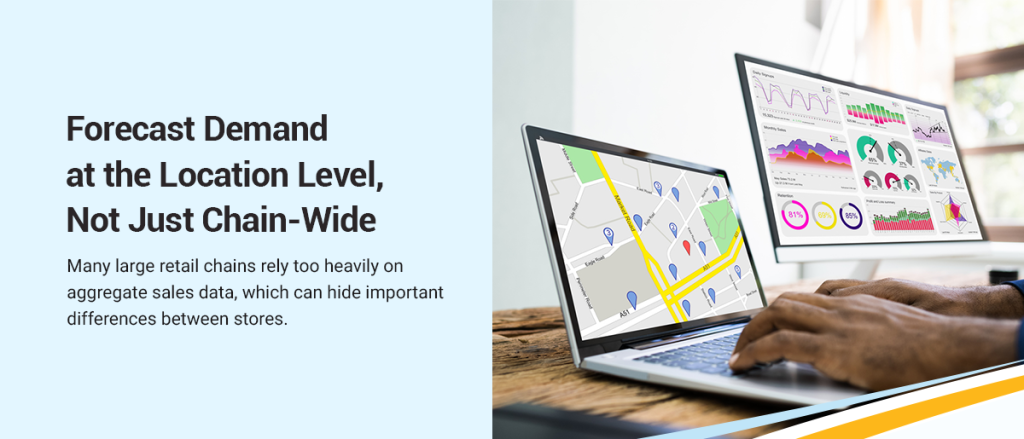
2. Forecast Demand at the Location Level, Not Just Chain-Wide
Many large retail chains rely too heavily on aggregate sales data, which can hide important differences between stores. Urban flagship locations, suburban stores, regional outlets, seasonal markets and event-driven locations may all experience different demand patterns. When inventory planning overlooks those local differences, retailers risk sending too much stock to some stores and too little to others.
The financial impact can be significant. Stockouts and overstocks cost retailers over $1 trillion annually. Together, these issues can lead to lost sales, markdowns, clearance costs and excess inventory that ties up working capital.
Location-level forecasting helps retailers allocate inventory based on each store’s actual demand instead of broad network averages. With the right inventory management system and logistics support, large retail chains can better anticipate demand shifts, reduce stockouts, limit overstock and keep inventory moving where it is most likely to sell.
3. Standardize Receiving, Tracking and Auditing Across Every Store
Forecasting and visibility tools are only as reliable as the information entered into them. If receiving records are incomplete or inaccurate, those issues can affect replenishment, fulfillment and chain-wide reporting. Consistent receiving checklists, barcode scanning, SKU logging and cycle counts help retail teams maintain cleaner inventory records across every location.
For large retail chains, even small process gaps can create bigger problems across the network. A missed scan, incorrect SKU entry or inconsistent receiving process at one store can affect broader inventory planning and make it harder for teams to trust the data they use.
Standardized auditing can also help retailers manage shrinkage. Regular cycle counts, clear receiving protocols and documented tracking processes give large chains a better way to identify discrepancies, investigate recurring issues and improve inventory accuracy over time.
Retail inventory handling processes are most effective when they are easy for teams to follow consistently. Large chains should document each step of the receiving process, define who is responsible for logging inventory updates and establish clear escalation paths when discrepancies appear. Store teams should also know how to handle damaged goods, returns, misplaced items and late shipments so those issues do not create confusion in the system.
These standards help every location work from the same playbook, even when staffing levels, store layouts or product mixes vary by market. Over time, consistent processes can make inventory records easier to maintain and trust. They also give leadership a clearer way to compare performance across locations, identify recurring process gaps and decide where additional training or logistics support may be needed.
Clear documentation also helps new employees follow the same process as experienced team members. When every store uses the same receiving and auditing standards, retailers can reduce confusion during busy seasons, product launches and chain-wide rollouts while keeping inventory updates more consistent across the network.
4. Use a Logistics Partner to Support Chain-Wide Execution
Centralized visibility, location-level forecasting and standardized receiving processes are easier to sustain when logistics execution is consistent across the network. As retail chains grow, internal teams may not always have the capacity, equipment or infrastructure to coordinate inventory movement across dozens or hundreds of locations on their own. A logistics partner can help support that execution layer.
Look for a provider with the reach and resources to handle multilocation complexity. Nationwide coverage can help support stores across the U.S., while asset-based operations with owned trucks and drivers can reduce reliance on outsourced transportation. Integrated WMS technology can also support real-time inventory visibility across the network.
Final mile delivery capabilities are especially valuable when products need to reach exact store locations, fixture areas or project sites. Project management experience can also help retailers coordinate rollouts, fixture installations and chain-wide inventory initiatives with fewer handoffs. When one partner provides warehousing, distribution, transportation and project support, retail teams can reduce coordination demands and keep inventory moving more efficiently.
Get Started With Corrigan Logistics
Effective inventory management isn’t just about knowing what’s on the shelf. It’s about having the systems, processes and logistics network needed to keep products moving where customers need them, when they need them.
Retailers that invest in visibility, accurate forecasting and standardized operations are better positioned to reduce costs, improve customer satisfaction and support long-term growth.
When your retail chain needs logistics support for multilocation inventory management, Corrigan Logistics can help. With nearly 100 years of experience, we support businesses that need reliable coordination across stores, warehouses and delivery points. Our asset-based model means we own our trucks and work with our own drivers, helping reduce reliance on outsourced transportation.
Our proprietary WMS supports real-time inventory visibility across your retail network. From warehousing to final mile delivery, Corrigan Logistics can serve as a one-stop resource for retail logistics support. Contact us online today or call 947-207-3076 to get started.